The first time Krystina Burton met Gabriel Solberg, she rolled her eyes.
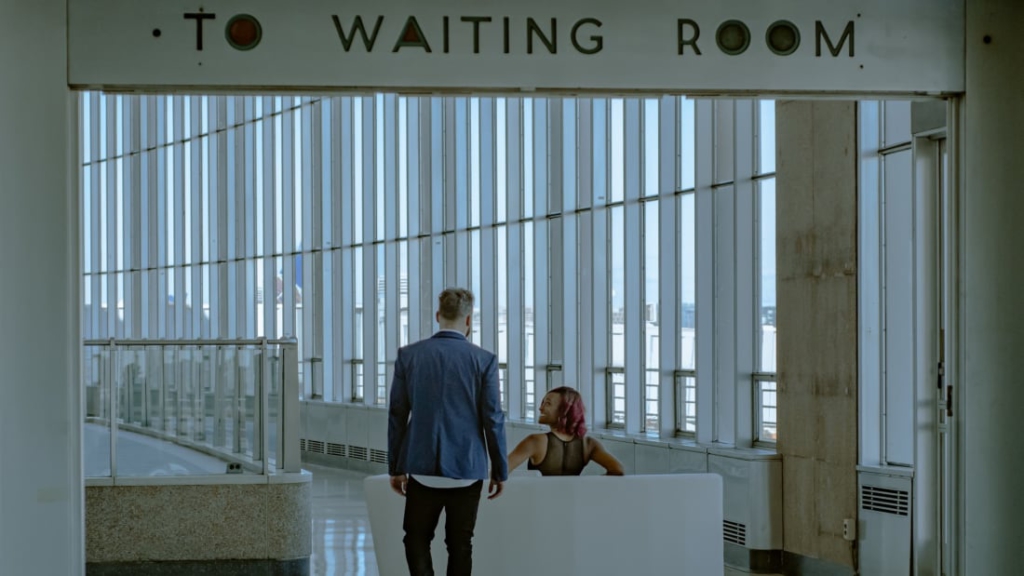
Burton, a then 30-year-old dancer living and working in Los Angeles, was waiting at JFK to fly home following an audition in New York. It was early in the morning. The terminal was mostly empty, so she had a row of seats to herself.
When a man plonked his bag on the floor and sat right next to her, Burton was irritated.
This was Solberg, then 34 and on his way back from visiting family in Europe. Bleary-eyed from an airport overnight layover, he was paying little attention to his surroundings.
“This guy doesn’t have spatial awareness,” Burton recalls thinking. The two strangers were sitting so close that Burton could see the seat number printed on Solberg’s plane ticket. She realized he had the plane seat next to her, and internally groaned. She wasn’t in the mood to spend six hours sat with someone who didn’t understand the concept of personal space.
This was July 2018. Reflecting on the moment now, Solberg is quick to defend himself, and remembers things slightly differently.
“That’s her perspective,” he tells CNN Travel, laughing. “When I went to that terminal, it was packed, it was full of people, and I just grabbed a chair that was empty. I only sat there for like five minutes.”
Burton says Solberg only sat down briefly because he jumped up the minute boarding was announced, only confirming her suspicions about his arrogant nature.
“I know that since we’re sitting next to each other, we must be in the same boarding group. But he’s already escaped, and he boarded the flight with a random group,” Burton tells CNN Travel.
Krystina Burton and Gabriel Solberg first met at an airport terminal, a moment they recreated in this later photo.
When Burton eventually boarded the Alaska Airlines flight and saw Solberg already settled in their row, she tried to put her headphones in quickly, to avoid any conversation.
“But I’m not fast enough, so he immediately engages me.”
Solberg hadn’t really noticed Burton in the terminal, but he spotted her as soon as she boarded the flight, walked up the aisle and approached his row.
He says he was blown away by her smile, and then something twigged.
“Hey, weren’t you sitting next to me in the terminal?” he said, grinning.”You were sitting next to me,” responded Burton, still smiling.
Burton’s first impression of Solberg as arrogant and self-centered melted away, and the two started chatting.
“I feel like the banter was immediate,” Burton recalls now. “As soon as I got on the plane and was getting to my seat, I feel like it just changed — there was no annoyance.”
Apple has lost its position as the world’s most valuable company amid a broad sell-off of technology stocks.
Saudi Arabian oil and gas producer Aramco has reclaimed the top spot from the iPhone maker for the first time in almost two years.
Investors have been selling shares in technology firms as they move into what they see as less risky assets.
Bitcoin, other major cryptocurrencies and digital assets have also continued to fall sharply.
Shares in Apple fell by more than 5% in New York on Wednesday to end the trading day with a stock market valuation of $2.37tn (£1.94tn).
That meant it lost its position as the most valuable company in the world to oil and gas producer Aramco, which was valued at $2.42tn.
It is the first time that Aramco has held the top spot since 2020. Shares in energy producers have risen this year as the cost of crude oil and natural gas have gone up.
Meanwhile Apple’s shares have fallen by almost 20% since the start of the year after a sell-off in technology stocks.
The technology-heavy Nasdaq closed 3.2% lower in New York on Wednesday after official data showed that US inflation remained near a more than 40-year high.
Rising prices have been the single biggest threat to the recovery of the global economy as it emerges from the Covid-19 pandemic.
Central banks around the world have responded to the problem by raising interest rates, which has triggered a move out of riskier investments over concerns that the higher cost of borrowing will slow down economic growth.
On Thursday Japan’s SoftBank Group reported a record loss of $26.2bn at its Vision Fund business as the value of its technology investments slid.
The loss was a stark contrast to a year ago when the company posted record annual profit.
Since then a number of companies SoftBank has stakes in, including ride-hailing firms Didi and Grab, have tumbled in value.
The move out of what are seen as risky assets also helped to push the price of Bitcoin below $27,000.
The world’s biggest and best-known cryptocurrency has now lost about 60% of its value since hitting a record high in November last year.
Ether, the digital coin linked to the ethereum blockchain network, also fell sharply again and has now lost more than 40% of its value in the last week.
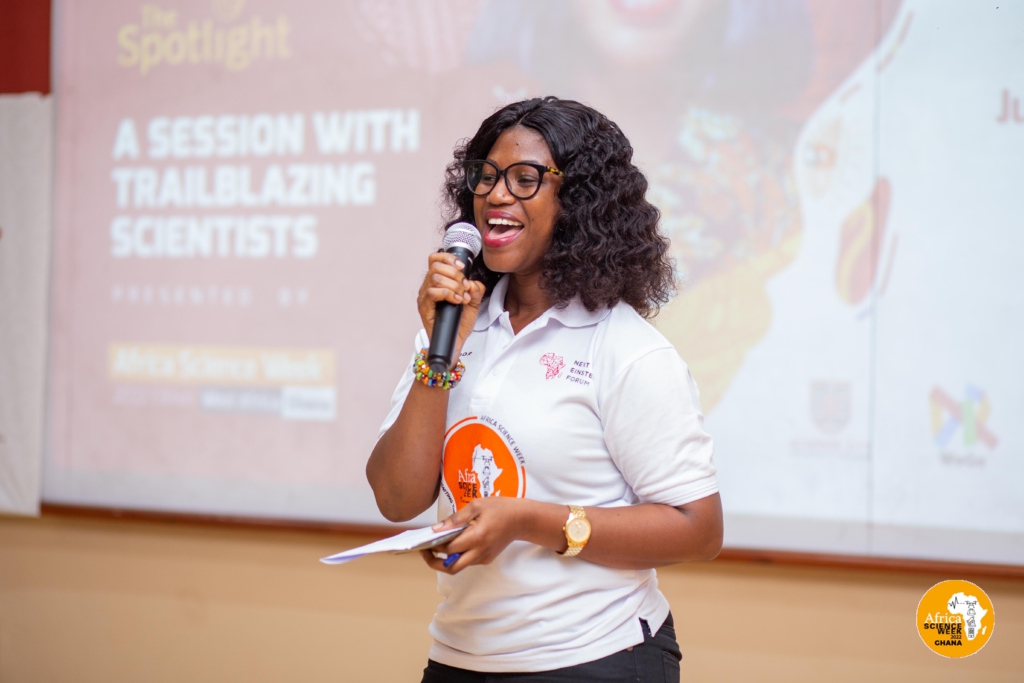
The Next Einstein Forum (NEF) has celebrated this year’s African Science Week 2022 by organising a forum involving some trail-blazing scientists at the Academic City University College Accra on Wednesday.
The African Science week celebrates the contribution of Africa and African researchers to the construction of the world’s science heritage.
The event is part of a series of events being organised across five African sub-regions for the first time this year with Ghana and Niger chosen as hosts for West Africa.
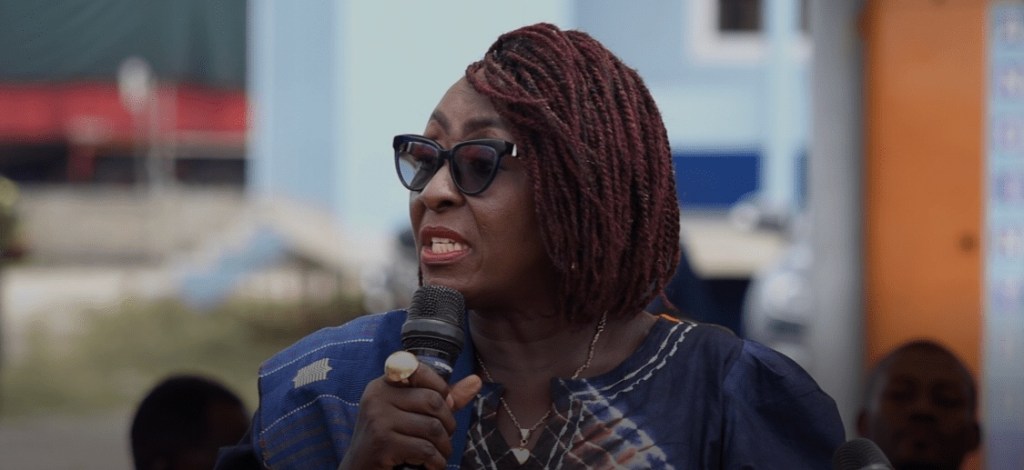
In an address, NEF Ambassador Justina A. Onumah welcomed the participants and expressed delight at having the relevant stakeholders present for the occasion.
She also highlighted the importance of leveraging science and technology for human development and the belief that the Next Einstein can be an African.
The theme for the celebration was “Using the transforming power of Science, Technology, Engineering, and Mathematics to propel the achievement of the Sustainable Development Goals”.
The ‘Spotlight session with trailblazing Scientists,’ which was organised by NEF in partnership with WeGo Innovate, Academic City, and Ghana STEM Network, brought together three crack academic researchers of repute including Prof. Elsie Effah Kaufmann, University of Ghana and the National Science and Maths quiz mistress, Dr Michael Osae from the Ghana Atomic Energy Commission (GAEC) and Dr Peace Amoatey, University of Ghana.
The session was skillfully moderated by Dr Kamila Kabo-bah of Academic City University College who also asked probing questions to the guest panel.
The in-person and virtual audiences were treated to cutting edge research presentations by Dr Amoatey who touched on ‘Waste Water Treatment for Irrigation’, highlighting the danger of bacteria and metal contamination of vegetables and water bodies, and proposing treatment using sand filters.
Dr Michael Osae gave a fascinating presentation that explored bioengineering in the insect world focusing on a case study of the Black soldier fly which has inspired the production of animal feed, and organic fertilisers while also highlighting untapped opportunities and potentials in the field.
Prof. Effah Kaufmann gave a lecture on demystifying Ghana’s National Maths and Science Quiz, noting its objectives and history from 1993, the challenging years, and its evolution to the present competition a lot of people have come to love.
The panel fielded questions from the audience during the mentoring session bothering on the individuals who inspired them to take science seriously, dealing with setbacks, how scientific studies could be converted to solving real-life problems, and how females can survive the male-dominated science field.
Prof Kaufmann advised the young scientists to prioritise their activities to achieve their aims in life by keeping their eyes fixed on the goal they set for themselves.
“Spend less time focusing on things that are not important. Prioritise and don’t pay too much attention to things that don’t matter. Solicit understanding and help from your family to achieve your aims. Help them (family) and do your best for them and by so doing they will also not disturb you when you really need it.”
Dr Amoatey, who is also a leakage management expert, said her dream is to see the Odaw river cleared of all its filth.
“My dream is to see the Odaw river completely clean. Engineering is not the solution. It is down to the behaviour of people. My dream is to be able to have a leakage system at Ghana Water Company to safeguard water management from the early stage to response, right to the end.
On his part, Dr Osae stressed the need for scientists to find a way of monetising their research and findings so it becomes easier for entrepreneurs to partner with them.
Another key highlight of the event was project presentations and exhibitions and demonstrations by some students from Academic City, Blue Crest and OpenLabs. Further, the Ghana STEM Network Team was also launched, coupled with STEM exhibitions from IOT Network Hub.
The event was attended by students and teachers of the Apostle Safo School of Arts and Science, Academic City and Blue Crest students, students from other academic institutions, science enthusiasts, and the media.
The weeklong event program began on Wednesday, May 11, 2022, with the Spotlight Session and ends on Thursday, May 19, 2022.
Other scheduled events include Africa Science Movie night on Friday, May 13, at the Ghana Tech Lab, Women-in-STEM Outreach to a junior high school, and the Climate Speaker Series to be held on May 19, 2022, at the ISSER Conference room.
Twitter has confirmed that two of its bosses are leaving the social media company in one of the biggest shake-ups since Elon Musk agreed to buy the firm.
The executives had been leading Twitter’s consumer and revenue operations.
From this week, the firm has also paused most hiring, except for “business critical roles”.
The move comes as the multi-billionaire Tesla boss moves ahead with a $44bn (£36bn) takeover of the platform.
“We are pulling back on non-labour costs to ensure we are being responsible and efficient,” a Twitter spokesperson told the BBC.
Kayvon Beykpour, who led Twitter’s consumer division, and Bruce Falck, who oversaw revenue, both tweeted on Thursday that the departures were not their decisions.
Mr Falck tweeted: “I’ll clarify that I too was fired by (Parag).” But he appeared to delete the tweet later. His Twitter bio now says “unemployed”.
Jay Sullivan, who was leading the consumer unit during Mr Beykpour’s leave, will become permanent head of the division. He will also oversee the revenue team until a new leader is appointed.
The Member of Parliament for Ketu South, Dzifa Gomashie, has appealed to President Akufo-Addo to urge President Faure Gnassingbé Eyadéma of Togo to open the land borders.
She lamented that though Ghana has opened its land borders, it’s Togolese counterpart has refused to open its side of the boundary, despite the ECOWAS directive to the contrary.
Speaking at a sensitization programme in Aflao on the reaffirmation of the international borderlines of both countries, she urged President Akufo-Addo to use his position as the ECOWAS Chairman and appeal to Togo to obey the directive.
“I want to use this platform and this opportunity to appeal to His Excellency, Nana Addo Dankwa Akufo-Addo, that Your Excellency, use your position as the Chairman of ECOWAS, appeal to His Excellency President Faure Gnassingbé Eyadéma to open the other side of the border, so my people can get access to their livelihoods”, she said.
She lamented that most livelihoods of residents in her jurisdiction and that of border communities in Togo are affected by the continuous closure of the border.
She indicated that the clarification that the boundaries would only be reaffirmed and re-demarcated as speculated, has allayed the fears that the exercise would antagonize any group of people.
Madam Gomashie lauded the work of the committee in ensuring that the international borderlines of Ghana and Togo are clearly visible to prevent conflict and cross border crimes.
He entreated people in the border communities in both Ghana and Togo to endeavor to sustain their cultural values and heritage, which “binds us together”, irrespective of the international boundaries.
She expressed hope that the reaffirmation exercise would not bring division but bind both countries together “to recognize the strength that each country brings to the table and which ultimately benefits our people”.
I would recommend anyone on the noble Platform to join my upcoming space on Twitter as We Discussed WordPress and it benefits. Tap on the link to see details .
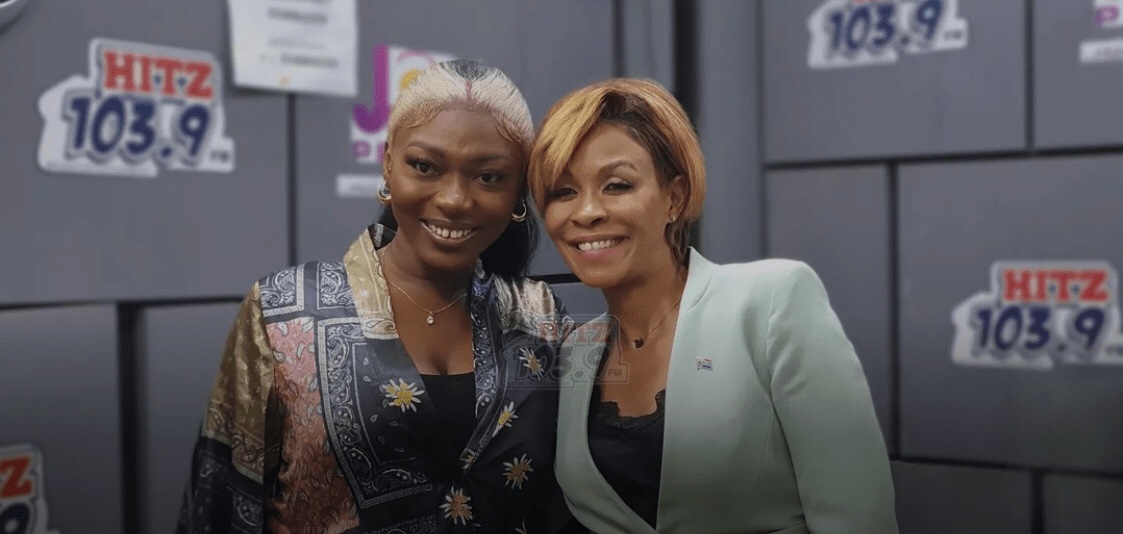
Musician SƐFA has apologised to the South African High Commissioner to Ghana, Grace Jeanet Mason after the singer broke protocol at the recently-held Vodafone Ghana Music Awards (VGMAs).
SƐFA won the VGMA ‘Best Afrobeats Song of the Year’ with her smash-hit single E Choke featuring Mr Drew on Saturday.
The singer’s plaque was presented by Grace Jeanet Mason.
The incident garnered a lot of bashing on social media against the Black Avenue Muzik’s signee.
Moments after the incident, SƐFA realised how demeaning the act was.
Unfortunately, SƐFA couldn’t approach the High Commissioner with an apology because she had left the auditorium.
On Wednesday, the Daybreak Hitz on Hitz FM team booked Grace Jeanet Mason for an interview regarding the incident and other matters.
The team reached out to SƐFA’s camp to admonish her to leverage the opportunity to apologize formally to the diplomat.
The singer nodded to the team’s call and agreed to appear on the show—an appearance which later turn out as a surprise to the S. A. High Commissioner to Ghana.
During the show, she pleaded with H.E Grace Jeanet Mason, and the public, saying the act wasn’t “intentional” and “expected”.
“Being Ghanaian and African, I think it’s best for me to even apologise first-hand before saying anything,” said the singer.View this post on Instagram
“I want to say I am very sorry for everything, Your Excellency. I was so overwhelmed with joy,” she added.
Seated next to her in the studio was the S.A High Commissioner, who interrupted SƐFA’s apology speech, saying “I did not notice anything my darling [SƐFA] I was just excited to be there, to present, to celebrate artists, and young women,” she said.
“It was a beautiful evening. Congratulations, once again,” she told SƐFA
A 14-year-old boy has lost his left forearm, and right foot due to the effect of battery acid poured on the limbs for allegedly stealing a bicycle.
The act was allegedly committed by a teacher at Nalerigu Senior High School, Ibrahim Salifu, popularly known as ‘Fire-fire’.
The two limbs were subsequently amputated by doctors at the Nalerigu Baptist Medical Centre due to the severity of the damage caused by the acid.
The boy was said to have been moving around with his bicycle searching for scraps, when he came across a bunch of empty tomato cans and decided to carry them away.
Gideon Wunduwa, the victim’s father, told JoyNews‘ Elliasu Tanko that his son did not have a carrier at the back of his bicycle, so he parked his and took another one with a carrier parked in front of a house without the owner’s permission.https://www.youtube.com/embed/mImSH0t5ues
“He picked another bicycle from the house to go and sell them [scraps] and come back.
“So he left the bicycle there and went and sold the tins, but when he returned, the man met him and said he had stolen a bicycle”.
According to Gideon Wunduwa, his son tried explaining the circumstances under which he swapped the bicycles, but the man turned a deaf ear to him.
He said his son was tied to a wooden bench and beaten with sticks for several hours before the acid was poured on him.
“The man tied him and called some people. They placed a plank of wood on top of two water drums, tied his legs and hands and hanged him while they were rolling and whipping him.
“So he told them they should exercise patience because he was going through excruciating pain, but they did not listen,” he said.
Mr Wunduwa further explained that the incident happened in the afternoon, but it was in the evening that the acid was poured on him.
“It happened at 12 pm, but when it was 7 pm, he instructed them to bring the battery water. They brought it and poured it on the boy’s legs and hands”.
The boy was later dumped in a bush after they had tortured him to unconsciousness.
He was, however, rescued and rushed to the Nalerigu Baptist Medical Centre in the northeast region.
The culprit, Ibrahim Salifu, was later arrested by the Police to face justice, but he was released after the Nalerigu Traditional authorities intervened.
A disgruntled Mr Wunduwa told Joy News he’s unhappy with the way the Police are handling the case.
He said the Police investigation into the matter doesn’t look promising, and he is calling on the general public to support him to demand justice for his son.
If, up to now, you’ve ever been stumped by something written in Krio or Ewe or Tigrinya then, unlike for more than 100 other languages, Google Translate was not going to help you out.
But that’s just changed as Google has announced the addition of 24 languages – including 10 spoken in Africa – to this function.
The new African languages are:
Bambara – spoken in Mali
Ewe – spoken in Ghana and Togo
Krio – spoken in Sierra Leone
Lingala – spoken in large parts of central Africa including the Democratic Republic of Congo
Luganda – spoken in Uganda and Rwanda
Oromo – spoken in Ethiopia
Sepedi – spoken in South Africa
Tigrinya – spoken in Eritrea and Ethiopia
Tsonga – spoken in South Africa
Twi – spoken in Ghana
Several other African languages were already available, including Amharic, Hausa and Somali.
In the past, the software used to translate as well as learn how to improve the interpretation relied on being fed material that had already been translated.
There is a large and growing amount of text in the more widely spoken and used languages – but this is not the case for many others.
Google has said that these new additions rely on novel software which does not require reference to previous examples.
Google Translate’s research scientist Isaac Caswell told the BBC that this work was part of “expanding coverage to many communities who were very much overlooked not just by Google but other technologies in general”.
But will the translations be accurate? Many polyglots have up to now noted problems with the languages already available.
“For many supported languages, even the largest languages in Africa that we have supported – say like Yoruba, Igbo, the translation is not great. It will definitely get the idea across but often it will loss much of the subtlety of the language,” Mr Caswell admitted.
With the new languages, he said, it would be no different. But the people who helped in the research said it was a good place to start.
“Some of the Krio [speakers] said, ‘Don’t let the perfect be the enemy of the good.’
“In the end, we have to make the call. And my impression from other people I have talked to was that it was a very positive thing for them.”
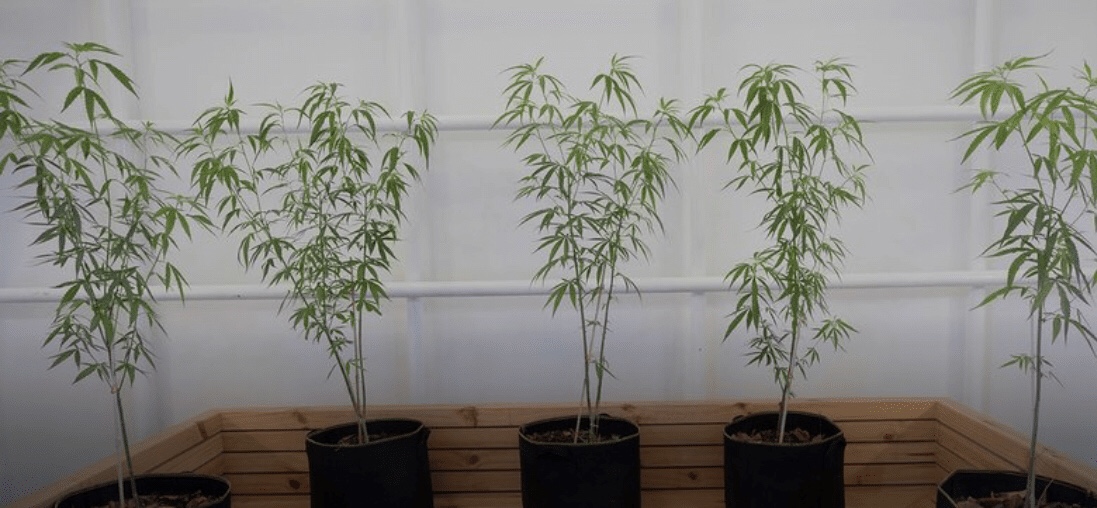
The Thai government will distribute one million free cannabis plants to households across the nation next month to mark a new rule allowing people to grow cannabis at home.
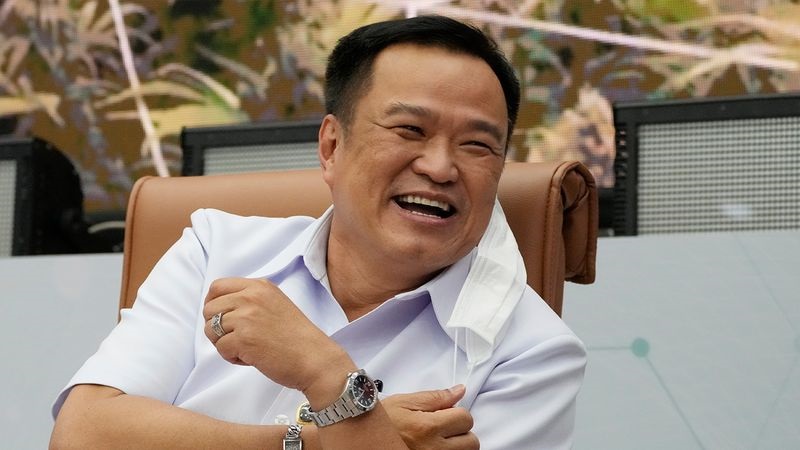
Health Minister Anutin Charnvirakul announced the move in a Facebook post on May 8 in which he expressed his intention for cannabis plants to be grown like “household crops”.
The new rule, which comes into force on June 9, will allow people to grow cannabis plants at home after notifying their local government, but the plants will have to be of medical grade and used exclusively for medicinal purposes.
Additionally, the cannabis cannot be used for commercial purposes without further licences.
The move is the latest step in Thailand’s plan to promote cannabis as a cash crop.
About a third of its labour force works in agriculture, according to the World Bank.
In a region notorious for harsh penalties towards illegal drugs, Thailand became the first country in Southeast Asia in 2018 to legalise cannabis for medical research and use.
The kingdom has also loosened local laws around cannabis.
Thai drinks and cosmetics companies last year rushed to launch products with hemp and CBD, a compound that does not give users a high, after their use was approved for consumer goods.
In a further Facebook post on May 10, Anutin noted that Thai companies registered to do so could sell cannabis products that contained less than 0.2 tetrahydrocannabinol, or THC, the part of the plant responsible for getting people high.
“This will enable people and the government to generate more than 10 billion baht per year in revenue from marijuana and hemp,” Anutin wrote.
Health Minister Anutin Charnvirakul announced the move in a Facebook post on May 8 in which he expressed his intention for cannabis plants to be grown like “household crops”. (AP Photo/Sakchai Lalit)
Kitty Chopaka, a Bangkok-based cannabis entrepreneur, told CNN the law was meant to pave the way for people to use the plant in medicinal teas or soups.
“It will still be considered criminal if you don’t have a legal prescription and you have to be a patient of some form of ailment for this to work,” she said.
“Only then will you be able to grow cannabis at home and use it however you like.”
She added that, even though recreational use of the drug remained illegal, “smoking weed will happen, and there’s no way the [government] can stop that”.
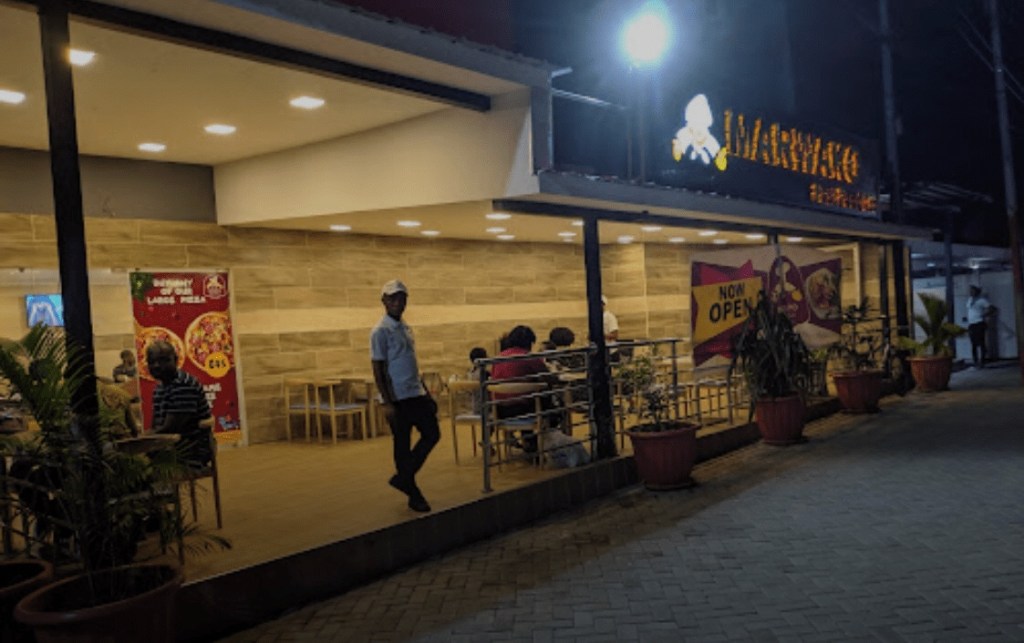
His statement has been rehashed by several other users who have also accused the fast food service of putting them in a similar situation since the weekend.
Some users are calling for the Food and Drugs Authority to take action against the company.
Meanwhile, some affected customers have hinted at filing a class action suit against the fast food service.
Marwako fast foods is yet to release a statement to address the concerns.https://platform.twitter.com/embed/Tweet.html?dnt=false&embedId=twitter-widget-4&features=e30%3D&frame=false&hideCard=false&hideThread=false&id=1524520078049431558&lang=en&origin=file%3A%2F%2F%2Fprivate%2Fvar%2Fcontainers%2FBundle%2FApplication%2F70DC1C4A-9BD0-46F3-8824-3AE8808A3BE5%2FMyJoyOnline.app%2F&theme=light&widgetsVersion=c8fe9736dd6fb%3A1649830956492&width=550pxhttps://platform.twitter.com/embed/Tweet.html?dnt=false&embedId=twitter-widget-5&features=e30%3D&frame=false&hideCard=false&hideThread=false&id=1524516149614067713&lang=en&origin=file%3A%2F%2F%2Fprivate%2Fvar%2Fcontainers%2FBundle%2FApplication%2F70DC1C4A-9BD0-46F3-8824-3AE8808A3BE5%2FMyJoyOnline.app%2F&theme=light&widgetsVersion=c8fe9736dd6fb%3A1649830956492&width=550pxhttps://platform.twitter.com/embed/Tweet.html?dnt=false&embedId=twitter-widget-6&features=e30%3D&frame=false&hideCard=false&hideThread=false&id=1524529140837371907&lang=en&origin=file%3A%2F%2F%2Fprivate%2Fvar%2Fcontainers%2FBundle%2FApplication%2F70DC1C4A-9BD0-46F3-8824-3AE8808A3BE5%2FMyJoyOnline.app%2F&theme=light&widgetsVersion=c8fe9736dd6fb%3A1649830956492&width=550pxhttps://platform.twitter.com/embed/Tweet.html?dnt=false&embedId=twitter-widget-7&features=e30%3D&frame=false&hideCard=false&hideThread=false&id=1524437298967949312&lang=en&origin=file%3A%2F%2F%2Fprivate%2Fvar%2Fcontainers%2FBundle%2FApplication%2F70DC1C4A-9BD0-46F3-8824-3AE8808A3BE5%2FMyJoyOnline.app%2F&theme=light&widgetsVersion=c8fe9736dd6fb%3A1649830956492&width=550pxhttps://platform.twitter.com/embed/Tweet.html?dnt=false&embedId=twitter-widget-8&features=e30%3D&frame=false&hideCard=false&hideThread=false&id=1524529370274033664&lang=en&origin=file%3A%2F%2F%2Fprivate%2Fvar%2Fcontainers%2FBundle%2FApplication%2F70DC1C4A-9BD0-46F3-8824-3AE8808A3BE5%2FMyJoyOnline.app%2F&theme=light&widgetsVersion=c8fe9736dd6fb%3A1649830956492&width=550pxhttps://platform.twitter.com/embed/Tweet.html?dnt=false&embedId=twitter-widget-9&features=e30%3D&frame=false&hideCard=false&hideThread=false&id=1524497086095446019&lang=en&origin=file%3A%2F%2F%2Fprivate%2Fvar%2Fcontainers%2FBundle%2FApplication%2F70DC1C4A-9BD0-46F3-8824-3AE8808A3BE5%2FMyJoyOnline.app%2F&theme=light&widgetsVersion=c8fe9736dd6fb%3A1649830956492&width=550pxhttps://platform.twitter.com/embed/Tweet.html?dnt=false&embedId=twitter-widget-10&features=e30%3D&frame=false&hideCard=false&hideThread=false&id=1524481597654904832&lang=en&origin=file%3A%2F%2F%2Fprivate%2Fvar%2Fcontainers%2FBundle%2FApplication%2F70DC1C4A-9BD0-46F3-8824-3AE8808A3BE5%2FMyJoyOnline.app%2F&theme=light&widgetsVersion=c8fe9736dd6fb%3A1649830956492&width=550px
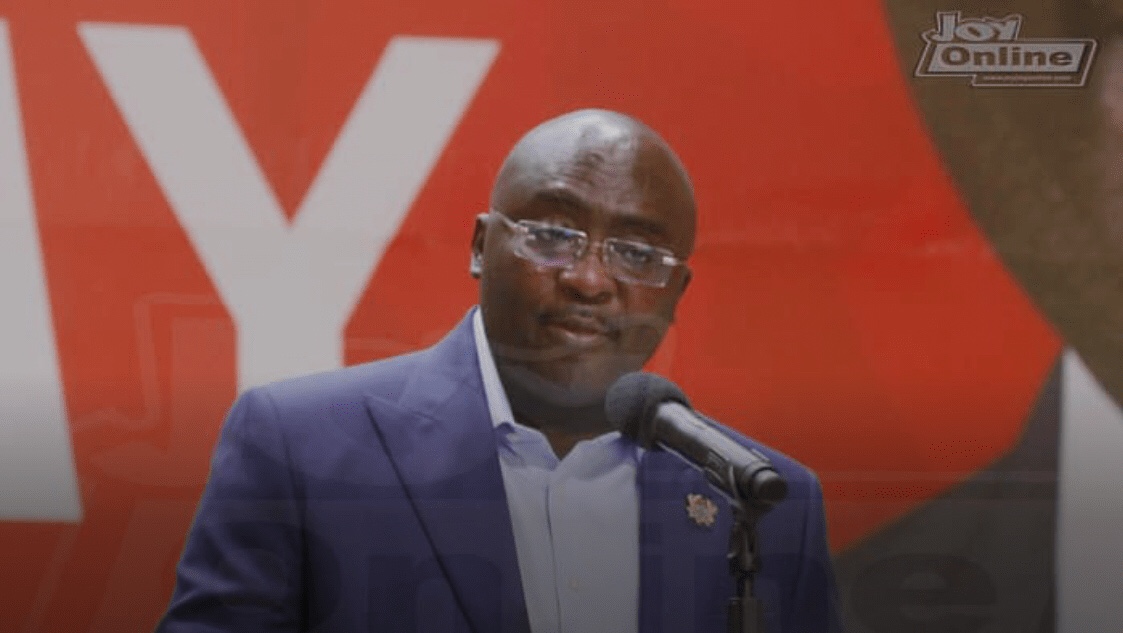
The Vice President, Dr. Mahamudu Bawumia, has donated one hundred new laptops to the University of Ghana Business School (UGBS), to support teaching and learning.
The Vice President made the gesture while launching the 60th Anniversary Celebration of the School.
According to him, the donation is a redemption of an earlier promise he made to the UGBS.
“The last time I was here, I think that was in January this year, in this very auditorium, the Vice Chancellor mentioned the imminent launch of a bold ‘One student, One laptop’ initiative. And in the context of the Business School, there was also an ICT need that the Dean was just mentioning.
I was very very inspired by this digitalisation drive that was taking place at the University, under the University of Ghana Business School, that on that day, I promised 100 hundred laptops to the University of Ghana Business School.
Today, Vice Chancellor, I am pleased to make good on that promise and I have here, 100 laptops for the University of Ghana Business School”, he said amidst applause.
A shot of the laptops which were donated by the Vice President at the University of Ghana Business School
Bawumia encouraged other alumni of the School to support their alma mater, to enable it realise its objectives.
The Vice President further congratulated the School for its strides over the years, despite the difficulties that confront it, “due to the resource inadequacy, coupled with the high expectations of stakeholders”.
He added that, “the educational terrain is also fast becoming turbulent, and I believe there is the need for the premier business school in Ghana, to show leadership in this endeavour of providing management education.
I genuinely believe that the University of Ghana Business School has the wherewithal to develop the necessary flair for setting the pace”.
Dr. Bawumia also underscored the need for the School to embrace technology, in its activities.
“Even though the COVID-19 pandemic was devastating, it has provided us all the opportunity to leverage technology in order to build on our competitive advantage. You have the opportunity to expose your students to artificial intelligence and help them explore big data, and the internet of things to help position them as global citizens.
With technology, the Faculty should find different ways to actively engage students, experiential learning, gain-based learning and problem-based learning to help impart soft skills such as autonomy, creativity, leadership and effective collaboration.
These are in no doubt linked to the 21st century skills of critical thinking and problem-solving, collaboration, agility and adaptability, initiative, entrepreneurialism, effective oral and written communication, assessing and analyzing information and curiosity and imagination. These must become integral in your curriculum revisions going forward”, he admonished.
The 60th Anniversary launch of the University of Ghana Business School, was organised at the R.S. Amegashie Auditorium of University of Ghana, on Tuesday, May 11, 2022.
The event was attended by some prominent members of the University community, persons from industry and academia, and a host of other patrons who graced the occasion in their numbers.
The special guest was the President of the Republic, Nana Akufo-Addo; who was represented by the Vice President, Dr Bawumia.
Speaking at the event, the Minister for Education, Dr Adutwum, also indicated that based on the history of the institution and its humble beginnings, he is happy about the current feat of the University of Ghana Business School, despite its challenges.
While commending the School on its successes, the sector minister also stressed the need for the UGBS to consider innovate policies to meet the needs of modern times.
Dr Adutwum, who is also the Member of Parliament for the Bosomtwe constituency said, “These are exciting times. Exciting times because the pandemic has given us the opportunity to innovate. Now it’s time for our schools to be teaching lean management and all the things that make organisations work in the middle of crisis.
So innovative strategies in the approach that you bring to bare and the education of the people who come to you, will go a long way in helping redefine the storyline and future of our nation”.
The theme for the launch of the Anniversary was, “The Future of Business Education in Ghana: Reflecting on the 60-Year Experience of the University of Ghana Business School”.
The Chairperson for the event was the Vice Chancellor of the University, Professor Nana Aba Appiah Amfo. She was however represented by the Pro Vice Chancellor from the Office of Research, Innovation and Development (ORID), Professor Felix Asante.
In attendance was also the Provost for the College of Humanities, Professor Daniel Ofori. Other dignitaries also included a former Vice Chancellor of the University of Ghana, Professor Akilagpa Sawyerr and the Dean of the University of Ghana Business School, Professor Justice Nyigmah Bawole.
At 38 years, George Andah had an encounter with Uncle Ebo Whyte who challenged him to write a book by age 40.
George decided to wait another decade to accomplish more and undertake the challenge by his 50th birthday.
It took him another two years, but last month, he finally published a book that chronicles his life experiences, ideas, and lessons learned.
But George Andah is not your typical everyday author, so why the decision to write a book?
“I primarily wrote for the youth of Ghana and Africa to tell them that it is possible. I also wanted to share a bit about my decision to go into frontline politics.”
Even before entering frontline politics, George Andah had already made a name for himself in the corporate space.
From being the Brand Manager for Guinness Foreign Extra Stout and eventually becoming the Marketing Director and the Innovations Manager for Guinness Ghana Breweries Ltd, to the Chief Marketing Officer for the then Scancom Ltd., a member of the MTN Group, Chief Marketing Officer of Bharti Airtel Nigeria, and Country Manager/Chief Operating Officer of Glo Mobile’s Ghana Operations, among many other positions, George Andah boasts of a CV, many young executives would die for.
And for someone who has achieved so much in the marketing space, one would have thought that George’s journey as a marketer started from his school training.
Interestingly, George studied Biochemistry for his first degree at the Kwame Nkrumah University of Science and Technology (KNUST). It was his second degree in Marketing that became the turning point in his career.
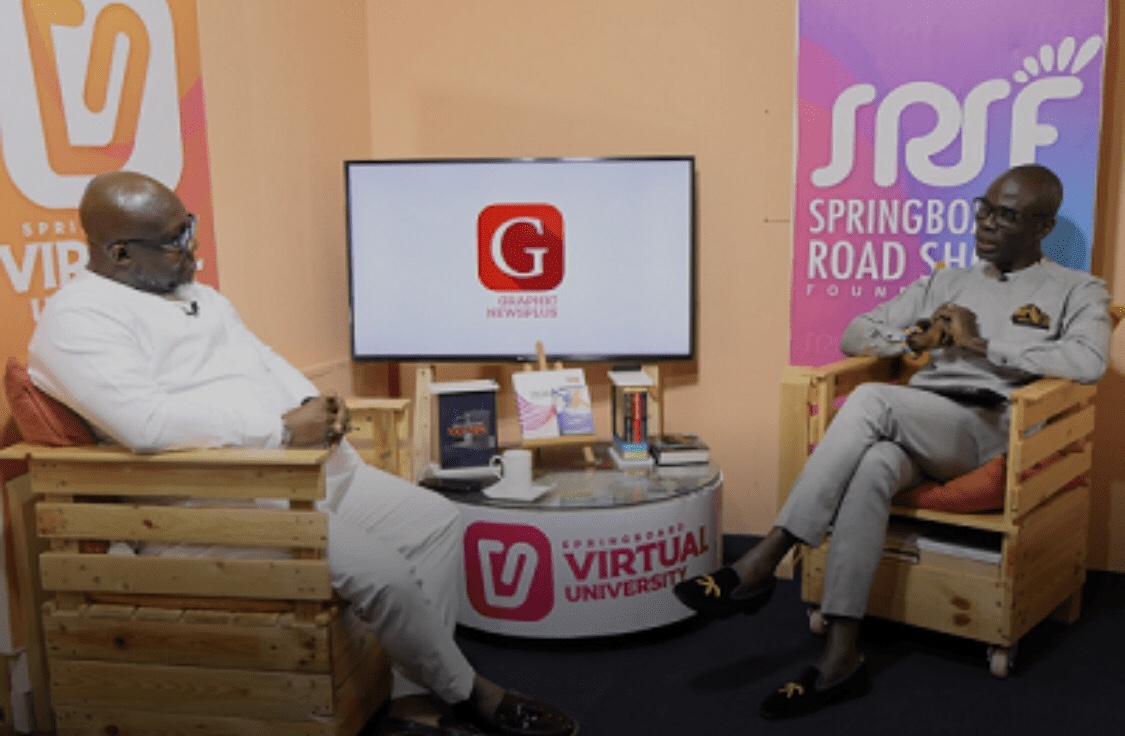
“Your mission is what God has planted in your heart and the impact you seek to create in society. It’s the joy that comes from touching lives like you’re doing here at Springboard.” He told Rev Albert Ocran in a discussion in The Engine Room series on the Springboard Virtual University Programme.
Growing up in at Ridge in Accra, George Andah saw a post in the room of his brother Eddie “I cried that I had no shoes until I met a man who had no feet.” That post became his signpost for fighting the challenges and setbacks he would later encounter in life.
You might have heard of the popular phrase “Ghana man time” where punctuality is thrown to the wind and people tend to start any event or program at the time most convenient for them. But for George Andah, punctuality means responsibility and it all started at Achimota School
“Being a bellboy at Achimota School taught me to be punctual. Extra curricula activities help to broaden your horizons and bring out the leadership and organizational skills in you.”
At KNUST, George organized the first-ever Kojo Antwi concert on campus for the Republic Hall Week celebration, and it was a blast. The SRC requested a repeat show, and according to him, it was a financial and technical disaster. Notwithstanding, he learned valuable lessons about supervision and the inherent dangers in the assumption that success is replicable.
The hallmark of a great leader is the number of people he has trained to take over from him when the time comes for him to move on, and George has always subscribed to that line of thought.
“I always handpicked and groomed one or two potential successors in case I had to move on. They often turned out so well that I often felt my leaving was justified to create room for them.”
George also indicated that he deliberately opted not to stay in one career role for too long. “I believe that with career movements, you learn from different roles, and different teams and test your ideas in different environments.”
George Andah is on a mission to do more and who knows, perhaps another book is in the offing. Or his business or political life is just about to jet off in a different direction. His passion to do more was fueled by the advice received from his late mother.
“My mom called me the final time before she passed and charged me to do more with my life, and that has stayed with me. Till today, I pause to think whether she would approve of something I am about to do.”
He charged the youth to cultivate the art of listening, noting that there is power in listening to what others are telling you. You may not always agree but listening helps you to make better judgements.
He cited the Member of Parliament for the Efutu Constituency, Alexander Afenyo Markin, as one of the people who constantly challenged him while he was with Occupy Ghana to step into the fray of active politics and directly contribute his quota to national development.
“People like Kwamena Bartels, Frank Damali, Gaddy Laryea, Norkor Dua and the late Torgbor Mensah influenced my professional journey and taught me so much of what I know.” He told Rev Albert Ocran when asked about the role of mentors.
Springboard is a virtual convocation of great minds and emerging leaders every Sunday on radio, television and online to share their life stories, experiences, lessons learned, and their impact on society. George Andah will feature in a two-part series slated to air on Sunday, May 15, 2022.
Academic City University College, a premium Science, Technology, Engineering, Arts, and Mathematic tertiary institution, has expressed its commitment to fostering an inclusive learning and working environment for its students and faculty community.
According to Prof. Fred McBagonluri, President and Provost of Academic City, the university acknowledges that each individual has a unique history and experiences that can be leveraged effectively for institutional and individual advancement.
“It is critical and everyone’s responsibility to advance the agenda of promoting and protecting diversity by valuing individuals without prejudice and by fostering an environment on campus that values equity and mutual respect,” he further indicated.
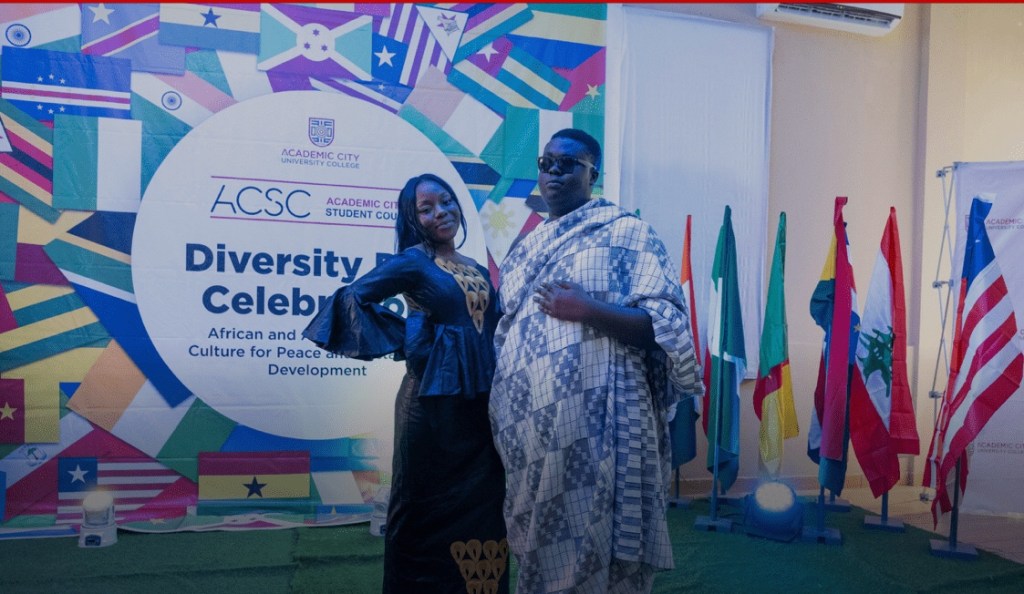
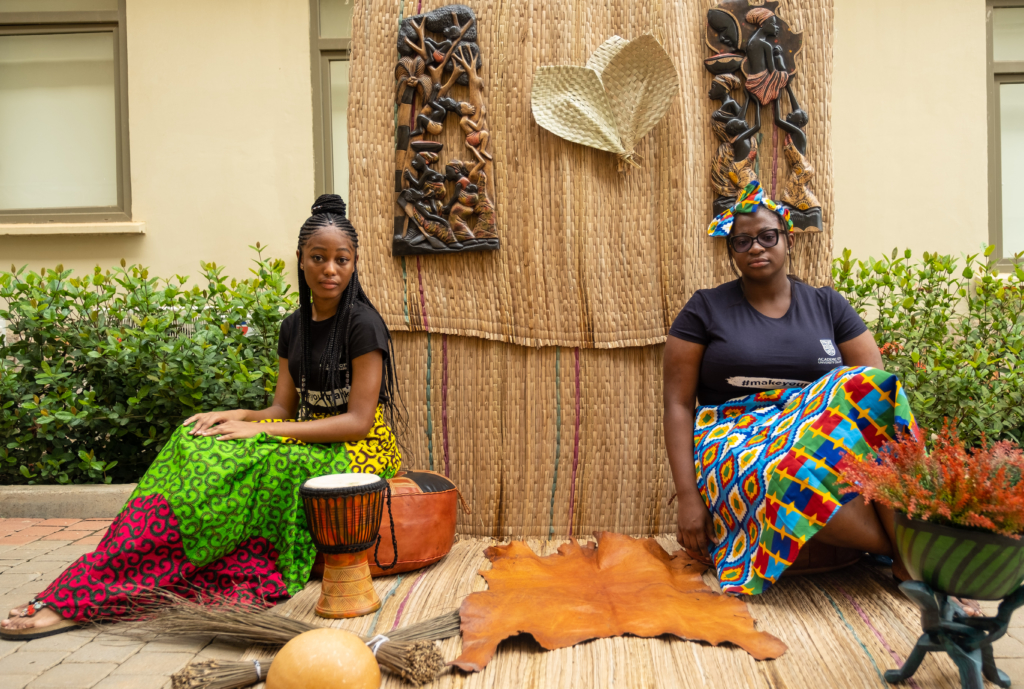
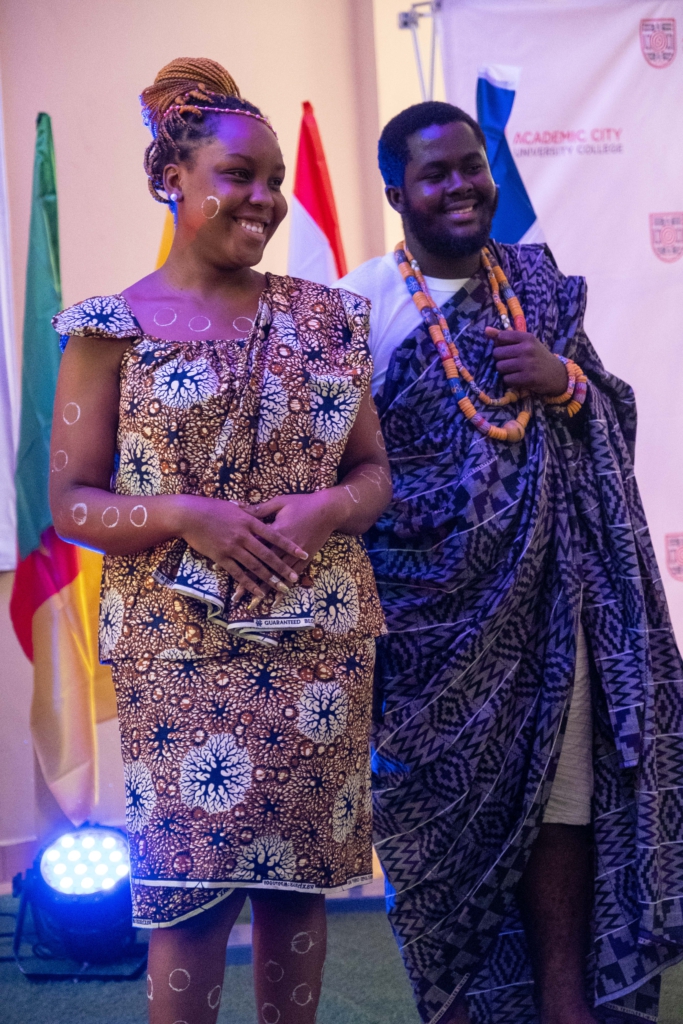
Students displaying their heritage
Prof. McBagonluri made this known during the university’s Diversity Day celebration.
The theme of this year’s conference was “African and Afro-descendant Cultures for Peace and Sustainable Development”. The one-day event aims to raise awareness of the importance of equality and inclusiveness.
Additionally, the event provided an avenue for celebrating and appreciating the diverse African cultures and backgrounds expressed through language, food, history, attire, music, dance, and literature.
Participating in this year’s event were students from the following institutions: Lancaster University Ghana, Webster University Ghana, Wisconsin University, and BlueCrest.
Students displaying their heritage
As a university with about 50 per cent of its students consisting of non-Ghanaian citizens, Academic City believes that promoting the continent’s diverse cultures is key to ensuring unity among the African people, which will significantly contribute to the development of the continent.
Dr Ransford Antwi, Head of the Social Sciences Department at Academic City, stressed the essential role that diversity plays in bringing people of diverse cultural backgrounds together in one place.
According to him, it was critical for Africans to unify and use our variety to bring progress to the continent’s economy.
Students displaying their heritage
“It is up to us as Africans to harness our variety to bring our natural resources and knowledge together in order to ensure that we become a major player in the global economic landscape”, he noted.
William Anosike, President of the Academic City Students’ Representative Council encouraged the students to form constructive relationships and to take advantage of the experience of their networks in order to advance their academic and professional careers.
Rihanna has announced that her Fenty Beauty and Fenty Skin products will become available in eight African countries including Ghana from the end of this month.
In a social media post, the pop star said she had “been waiting for this moment” and that this was “just the beginning”.
Rihanna, whose full name is Robyn Rihanna Fenty, launched Fenty Beauty in 2017 in a partnership with luxury goods company LVMH (Moët Hennessy Louis Vuitton).
She is worth $1.7bn (£1.2bn), with an estimated $1.4bn coming from the value of Fenty Beauty.
The company reportedly made $100m (£72m) in its first 40 days.
It makes more money than other celebrity-founded beauty brands such as Kylie Jenner’s Kylie Cosmetics, Kim Kardashian’s KKW Beauty and Jessica Alba’s Honest Company, according to Forbes.
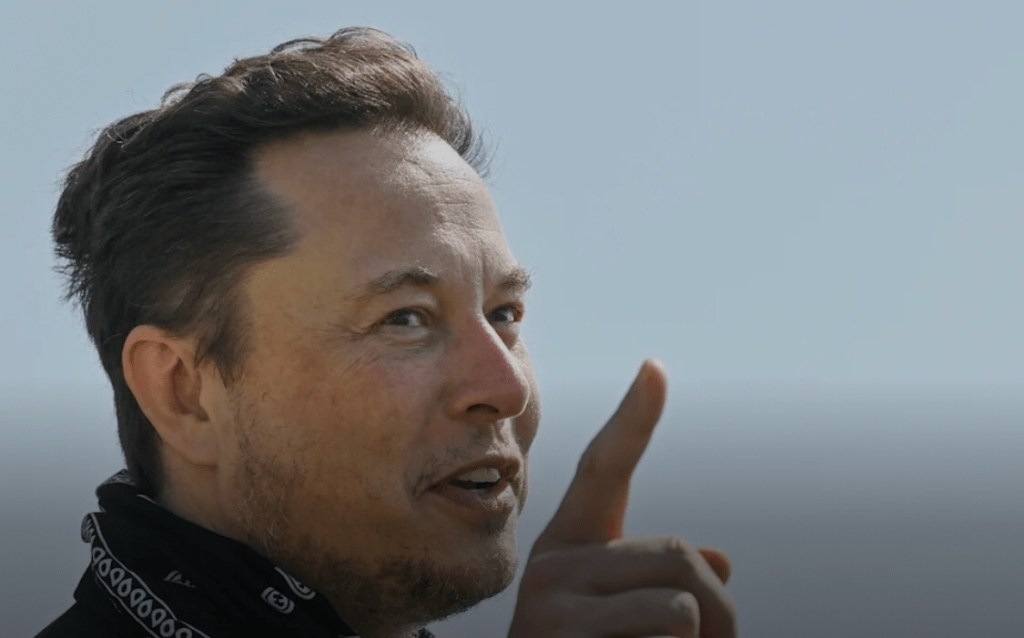
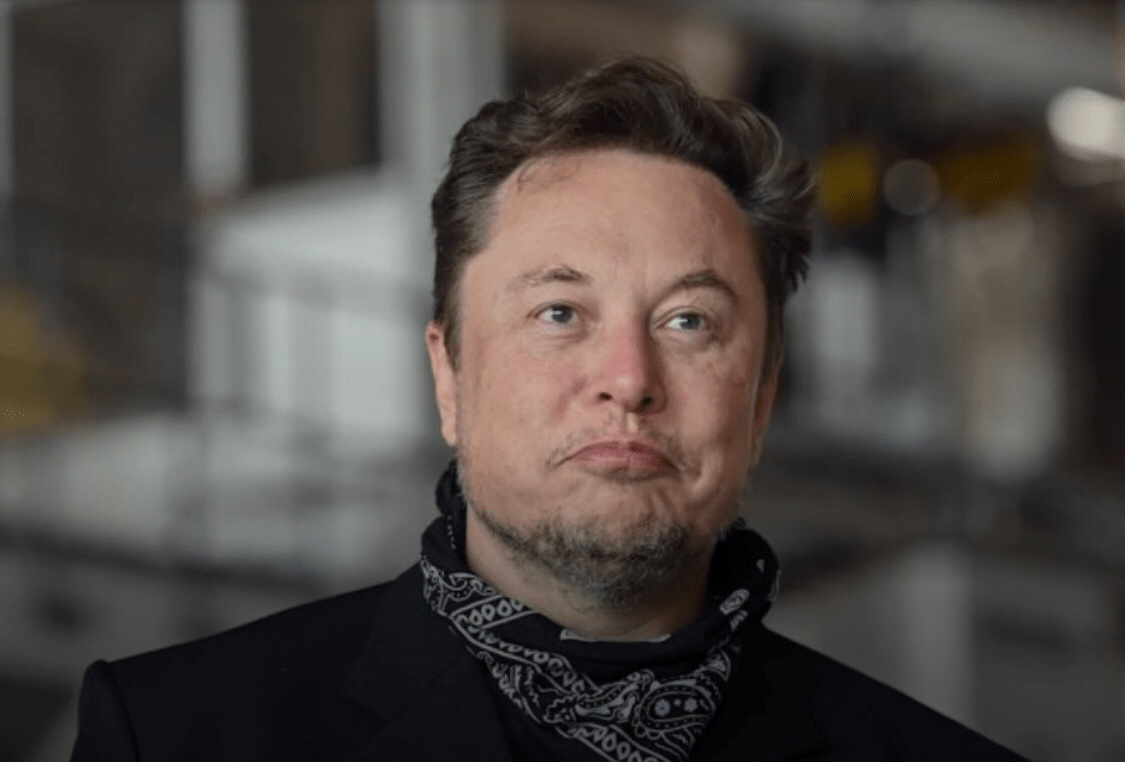
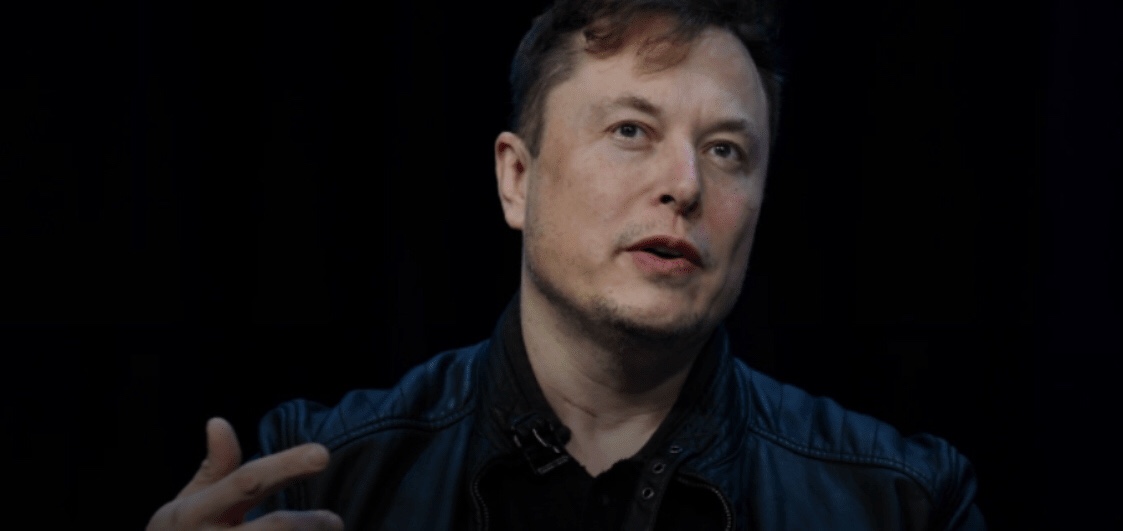
Elon Musk says if his bid to buy Twitter is successful he will reverse Donald Trump’s ban from the platform.
The richest man in the world agreed a $44bn (£34.5bn) takeover bid with the Twitter board last month.
But he said it was not a done deal and that ideally it would be completed in the next two to three months.
Twitter’s decision to ban the former US president was “morally wrong and flat-out stupid”, Mr Musk told the Financial Times Future of the Car summit.
In January 2021, Twitter said Mr Trump’s account was “permanently suspended due to the risk of further incitement of violence” following the storming of the Capitol.
But the Tesla owner said: “I would reverse the permanent ban but I don’t own Twitter yet so this is not a thing that will definitely happen.”
He said the ban had not silenced Mr Trump, but by making him move onto his own Truth Social site, it had amplified his voice among the far right.
He pointed out that Mr Trump had previously said he would not return to Twitter even if his account was reinstated.
Victory
Mr Musk said he had spoken to Twitter co-founder Jack Dorsey on the subject of locking users out of their social media accounts in response to offensive tweets.
“He and I are of the same mind that permanent bans should be extremely rare and reserved for accounts that are bots or scam accounts,” he said.
Mr Musk said if someone tweeted something “illegal or otherwise destructive to the world” there should be temporary suspension or the post should be made invisible.
He said Twitter needed to build more trust by sharing its algorithm and asking people to make suggestions on how to improve it.
He said the company had a strong left bias because of its origins in the San Francisco tech community and needed to be “more even-handed”.
“Victory would be the far right 10% and the far left 10% are equally upset,” he said.
Dr Catherine Flick, an expert in computing and social responsibility at De Montfort University, told the BBC’s Today’s programme her team had “very strong evidence to suggest [Mr Musk] is completely wrong” about the impact of Mr Trump being removed from Twitter.
“Removing Donald Trump from Twitter actually decreased the amount of polarisation,” she said. “It removed a platform for him to stoke animosity and division between people within the platform.”
Ms Flick added there were a “lot of people” who were worried about Mr Musk “essentially having the keys to this… social media platform to reign over it like a king or an emperor like he seems to want to do at the moment”.
Last week activist groups wrote an open letter to Twitter advertisers warning that under Mr Musk’s management, “Twitter risks becoming a cesspool of misinformation, with your brand attached”.
In the US, White House press secretary Jen Psaki said that the Biden administration wants online platforms to protect freedom of speech but also ensure they are not forums for disinformation.
Ms Psaki said allowing Mr Trump back on Twitter or not would be a decision for the private sector company to make.
This is the furthest Mr Musk has gone – saying in the strongest terms that he thought Mr Trump’s ban was wrong.
However, for those anticipating the former President’s imminent return to Twitter, think again.
To start with, Donald Trump has said that he doesn’t want to come back to Twitter, preferring instead to post on his own social media platform, Truth Social.
Of course, Mr Trump might revisit that decision if he made a tilt at the US presidency in 2024.
But there are other hurdles too. For ones, the world’s richest person made it clear that the deal was far from being done.
Mr Musk came across as less confident about the acquisition than previous statements. He emphasised that there hadn’t been a shareholder vote on the deal and that lots of questions still needed to be answered.
That might reflect the fact that his financial position is looking slightly more precarious than before.
Most of Mr Musk’s vast fortune is tied to Tesla stock – which has fallen in value by $350bn since he announced he had acquired shares in Twitter on 4 April.
The door then is certainly ajar for Mr Trump’s return. It is as open as it has been since the Capitol Hill riots. But don’t expect him to be tweeting anytime soon.
Speaking via video link, the Tesla boss said the company’s goal of making 20 million electric vehicles by 2030 was an aspiration not a promise.
But he said: “I’m confident that we will be able to sell all the cars we can make.”
He added: “At the moment the lead time is ridiculously long, so our issue is not demand, it’s production.”
Mr Musk said Tesla could stop taking orders beyond a certain period of time.
Earlier on Tuesday, Twitter shares fell to a level that indicated the stock market believed it was unlikely that Musk would make the acquisition for $44bn, as he originally agreed.
Mr Musk’s decision to go after Twitter has concerned some Tesla investors and put pressure on the stock.
Addressing concerns that his planned takeover of Twitter could distract him from his chief executive job at Tesla, he said he would remain at the car company “as long as I can be useful.”
He said China would account for 25% to 30% of Tesla’s sales long-term. He said he was not expecting to open any additional plants in China in the near future but would be expanding the Shanghai Factory.
Mr Musk has an estimated net worth of around $250bn, mostly due to his Tesla stake.
He also has a controlling stake in the rocket company SpaceX, which is estimated to be worth $100bn.
He said it was his aim to get an uncrewed vehicle known as Starship to Mars in three to five years with a crewed mission before the end of the decade.
Video games publisher Electronic Arts says it is going to stop making Fifa branded football titles.
Its EA Sports subdivision made the first Fifa game in 1993 and has been in charge of the franchise ever since.
It is one of the most profitable brands in gaming history, but the cost of the licence was one reason why the decision was made to ditch the partnership.
EA will continue to make football video games, but from 2023 they will come under a new banner, EA Sports FC.
While the gameplay mechanics and core modes of play will be similar to what players have come to expect in recent years, this change will likely see the title offer a broader range of other experiences, beyond just the ability to play.Speaking to the BBC, David Jackson, vice president at EA Sports, explained that the studio thinks it’s time to move in a different direction in order to build a “brand for the future”.
Although the details of those experiences are vague at the moment, it’s fair to assume that being able to watch real-life matches, experience Fortnite style live in-game events and have access to a broader range of branded in-game items are the kind of things EA would like to be able to offer.
Jackson says: “The world of football and the world of entertainment are changing, and they clash within our product.
“In the future our players will demand of us the ability to be more expansive in that offering. At the moment, we engage in play as a primary form of interactive experience. Soon, watching and creating content are going to be equally as important for fans.
“Under the licensing conventions that we had agreed with Fifa 10 years ago, there were some restrictions that weren’t going to allow us to be able to build those experiences for players.”
The Fifa franchise has been so successful in part down to detailed licensing agreements, that allowed for accurate representations of team kits, players faces and stadia to be seen on screen.
Players have been able to play as Premier League teams like Liverpool for years whereas competing games like Pro Evolution Soccer, offered fictional teams like Merseyside Red.
EA say they will continue to offer real-world experiences, having signed up 19,000 athletes, 700 teams, 100 stadiums and over 30 leagues for future games.
They include the Premier League, Bundesliga, La Liga and Uefa.
However, the move means that games released to tie-in with the World Cup, such as Fifa: Road to World Cup 98, will no longer be made by EA.
There will be one final Fifa release, with this year’s edition – Fifa 23 – on sale this autumn as usual.
EA Sports FC will hit the shelves in late 2023.
EA is one of the games companies that has faced fan backlash over its approach to in-game purchases. No doubt some of the questions about their new franchise will surround the financial model and plans for monetisation, which are yet to be revealed.
The move is a gamble for EA, whose fortunes have been closely tied with Fifa for decades, and Jackson accepts that, saying: “It’s a big moment for the organisation. Interactive football experiences have been central to what has made EA Sports successful over the last 30 years.”
Making sure the majority of the millions of current Fifa players switch to the new title will be vital for the company to be able to maintain important licensing partnerships in the future. They are an essential part of its success.
Electronic Arts struck the last licensing deal with Fifa in 2013 and it has been reported that football’s governing body had put the price of the licence up significantly – this time to more than $1billion dollars per four-year world cup cycle.
When asked if moving away from Fifa was purely a financial decision, Jackson said “it wasn’t ultimately down to money” but accepted it did play a crucial role in the decision-making process.
“Money plays a critical role in most negotiations, but the reason we are doing this is to create the very best experiences we can for both players and partners. As part of that you consider whether or not your investment in one place is better or worse than an investment in another.
“On balance, over time, we felt that our investments were better suited in spaces that were most important to players, like the different experiences we can now build in the game. For our partners, it’s the way we can welcome and engage them into a platform that talks to 150 million young football fans around the world.”
As for football’s governing body, last year it said it was engaging with developers, investors and analysts to come up with its future strategy for gaming, eSports and interactive entertainment, indicating that knew this change was coming for some time.
The BBC has contacted Fifa for comment, but has yet to receive a response.
“Change is always going to be concerning for people at first,” says Jackson.
“In terms of things that they’ll miss, players will notice only two things: The name and a World Cup piece of content every four years. Outside of that, very little will change about the things they know, and love about the current Fifa products.
“Probably the easiest thing that we could have done would have been to maintain the status quo. Fifa has been an incredibly successful game over time, but there are moments when you need to consider what the future looks like and we feel like building our own brand is the best for us.”
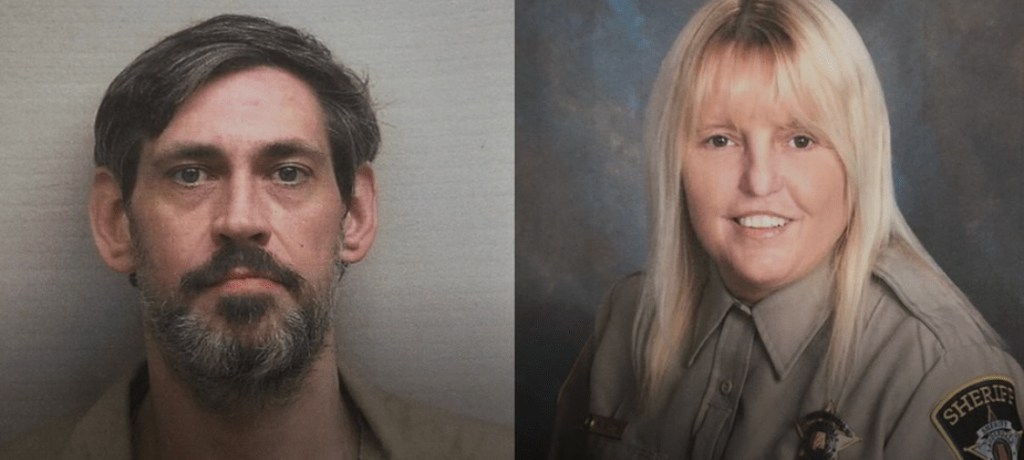
A female prison guard who went on the run with a murder suspect from an Alabama jail has died after shooting herself as the pair were caught, police say.
Vicky White, 58, died in hospital after she and Casey White (no relation), 38, were arrested in Indiana following a police chase.
The two had vanished from a prison in Lauderdale County on 29 April.
They are believed to have been romantically involved.
According to officials, they were last seen as she was transporting him to a bogus mental health evaluation.
It was Ms White’s last day at work before retirement. She had recently sold her home and told colleagues she planned to spend more time at the beach.
Late on Monday, the Vanderburgh County Coroners Office confirmed that Vicky White died in a local hospital after shooting herself during the arrest.
More information on her death is expected to be released on Tuesday following an autopsy.
Lauderdale County Sheriff Rick Singleton said earlier that the couple’s vehicle crashed after a police chase in Evansville, Indiana, at which point Casey White surrendered.
The US Marshals Service said the two had previously been last seen on Friday driving a copper-coloured Ford Edge with an Alabama registration plate.
On Monday, Sheriff Singleton described the 6ft 9in Casey White as “extremely dangerous” and advised law enforcement not to “take any chances” with him.
Meanwhile, Ms White had a spotless record as a prison guard.
“I would have trusted Vicky with my life. I really mean it,” Lauderdale County District Attorney Chris Connolly told reporters. “If we needed something from the jail, she was our go-to person, solid employee. That’s why it’s so shocking.”
Casey White was charged in September 2020 with murder over the stabbing of 58-year-old Connie Ridgeway. He was already serving 75 years for a series of violent crimes in 2015, including burglary, vehicle theft and a police chase.
He allegedly confessed to the murder, but later pleaded not guilty by reason of insanity, and was awaiting trial at the Lauderdale County Jail when he disappeared, authorities added.
One of the most anticipated sports autobiographies in Ghana’s recent history was launched on April 30.
‘LeGyanDary’, by former Ghana captain Asamoah Gyan, will hit the bookshelves this month after a star-studded launch led by the President of Ghana, Nana Akufo-Addo.
Joy Sports, in collaboration with King-Dawie Publishers, will give readers excerpts of the book.
Here, Gyan takes us to what he considers one of his most memorable performances as a Black Star: when, despite being very ill with malaria, his late, late goal qualified Ghana past the group stage at AFCON 2015.
*
We faced the might of Algeria on a cold evening on Friday, 23rd January, 2015. I walked onto the pitch breathless, looking pale and sickly but yet with the heart of a warrior ready to cause damage to the opponent. My body wanted to sit down but my love for the team and my country wouldn’t let me.
The game started and I had a chance but couldn’t do much with the ball. The Algerians, realising how unwell I was, kept pushing me off the ball at the least opportunity. I kept pushing on but lacked the characteristic sharpness of my play. The team tried to keep the game going by helping me in attack. Everyone realised how ineffective and out of place I was on the field.
It was so bad that the coach called me and asked if I was ready to be subbed. I know how much respect Avram had for me and coupled with the fact that I was a captain, he understood the need for me to be supportive of his actions. I explained to him that I had the inkling that I would score and he should give me some more time. I felt there was something ahead that would open up a chance for me to get that all-important goal.
During halftime, things seemed gloomy but my presence in the dressing room uplifted the team. I encouraged them not to give up and push harder. I told them we had victory assured and after the 90 minutes, we would be victorious. Avram stood smiling at the passion with which I spoke. I am sure he enjoyed watching the captain exert himself this well on the other teammates. We returned to the pitch with a lot of confidence.
In the second half, things got tougher for me. I felt awful. My whole body ached, excruciatingly. I took each step with great difficulty. Running left me breathless. Each attack saw me gasping for air. The earth would be spinning at times and I had to steady myself.
The Algerians had a clear chance to score but they missed after the shot went wide of the goal. It was still a goalless draw in the 90th minute. As I trudged along the pitch, I wondered if my presence had counted for nothing. Was all the pain in vain? Had I risked my life for nothing at all?
I reminded myself that I had done my bit and pushed as hard as I could and even if we drew the game, I had done my bit to ensure the team qualified. In the 92nd minute, the worth of that sacrifice was seen. Wakaso had the ball in our half. He saw me making the run. Till date, I still wonder why he took that chance to try and reach me.
I mean I had been woeful through the game and lacked any possibility of getting a goal. But he still believed in me. He hit the ball towards me. It was a long pass from our half to attack. When the ball was in mid-flight, a lot of things went through my mind. Should I chase and see what comes out of it? Or I should just let it go.
I was exhausted after running around for 90 minutes. But when the ball hit the ground I knew I could do it. It was a do or die affair for me. I knew this was less than a half-chance but everything was possible.
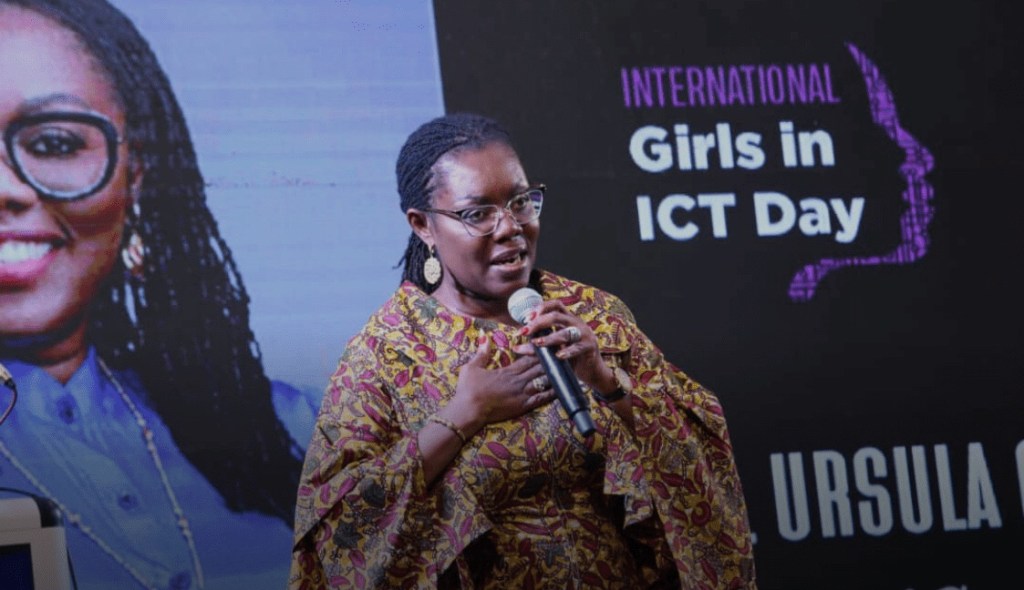
Minister for Communications and Digitalisation, Ursula Owusu-Ekuful, has said that the new Ghanaian economy needs the use of technology in trade and business activities to make a good living, hence the role of government in ensuring ICT education for girls across the country.
According to her, it is necessary for all female students to participate in Girls in ICT initiative.
One thousand girls are benefiting from the Bono region’s programme which is part of the quest by government to bridge the gender gap in technology with support from the Ghana Investment Fund for Electronic Communication, GIFEC.
“The direction in which the world is moving demands the use of ICT. What ever you want to do, even as a farmer or trader, ICT education is very important”, she mentioned
“ICT has become an enabler in the new economy and government is bent on exposing you girls and other young ones to the new trend” she said.
Madam Owusu- Ekuful challenged the students participating in the regional Girls in ICT programme to take advantage of the initiative to excel in the field of ICT and Science.
“It’s a privilege and an opportunity for some who have been fighting for but haven’t gotten the opportunity. So if you have it, make the best use of it now.
She advised the students to work hard because, hard-work doesn’t kill but rather makes one to adept in whatever he or she does.
“You are an Apple of God’s eye; God created you well therefore women are very important. We are perfection of creation, so try to reinforce yourself with a positive image as a perfect creation of God and never be discouraged”.
She also took inspiration from the 11 year old Princess Kumi, winner of the Bono East Girls in ICT to share some experiences with the girls on the programme so far.
The Minister used the theme for this year; “Access and Safety” to inform the girls about the risk of abusing the internet.
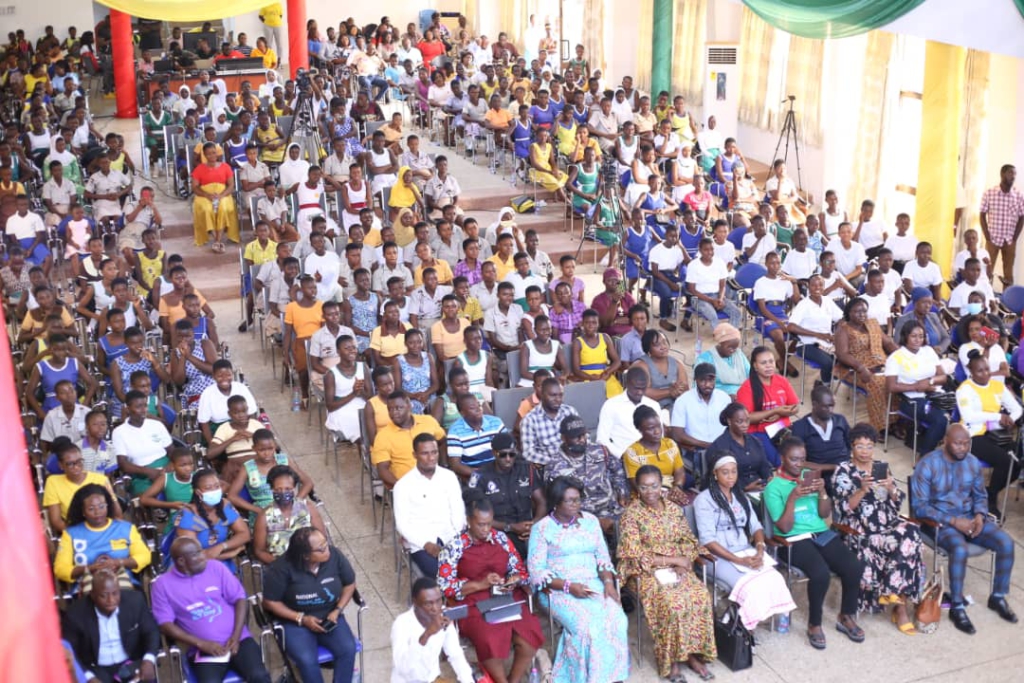
Selected Schools from all the 12 districts in the region participated in the mentorship programme with support from the regional education service.
Some teachers from the various districts were also trained as part of the initiative to impart the knowledge to other students that may not get the opportunity to participate.
Chairperson of the Mentorship programme, Dr. Seyram Blossom Setufe, Acting Head, Department of Fisheries and Water Resources, School of Natural Resources boosted the morale of the girls and urged them to become scientists and IT experts in the future.
“I will like you to pay attention, take note and develop interest in the field of engineering. Let your ears be open for the reason we are here and have that character and mindset that you can do it as an IT specialist or engineer” she advised.
There was training in coding which gave the girls the opportunity to explore the world of technology, through the creation of websites, computer games, interactive arts, mobile apps, and animation stories, using various programming languages.
She challenged the girls to stay focus and develop interest in ICT subjects.
Dr. Mercy Badu from the Department of Chemistry at the Kwame Nkrumah University of Science and Technology exposed the girls to some tips that will support their learning process in the field of Science and ICT.
According to her, there are limited ladies in the field and the need to bridge the gap through the Girls in ICT initiative.
Other mentors included Juanita Ahia Quarcoo, Lecturer at the Department of Computer Science, Sunyani Technical University; Faiza Umar Bawah, Lecturer Department of Science and Informatics, University of Energy and Natural Resources
Female Engineers from MTN were given the platform to share some experiences with the girls as well.
The Mentorship Day event is part of the Girls in ICT Initiative aimed at giving the girls the opportunity to interact with ladies in the field of ICT and Science education.
As part of strategies to both ensure that Ghana achieves the Sustainable Development Goal (SDG) 5, and Ghana’s ICT4AD Policy on bridging the gender digital divide, the Ministry of Communications and Digitalisation, through its agencies – GIFEC, NCA and the Kofi Annan ICT Centre of Excellence, has expanded the scope of the GIICT event.
Interestingly, over 60 percent of the girls trained, have no prior knowledge or experience in the use of computers.
The Girls in ICT programme, was introduced in 2012 by the International Telecommunications Union to empower and encourage girls and young women to acquire digital skills and consider studies and careers in the growing field of information and communication technologies.
Ghana, has adopted this initiative and observed it on a regional basis. It has already been celebrated in Greater Accra, Ashanti, Northern, Volta, Western, Western North, North East, Central and Oti Regions.
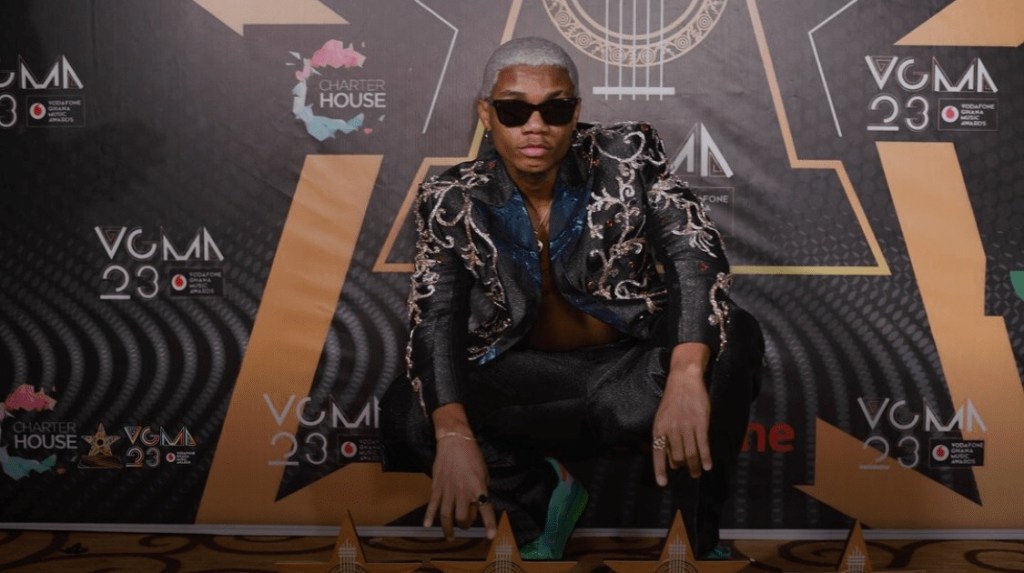
Reigning VGMA Artiste of the Year, KiDi, has revealed that there is a roadmap to winning at Lynx Entertainment.
This comes after the singer picked up five awards; Album of the Year, [Golden Boy]; Afrobeats/Afropop Artiste of the Year,Artiste of the Year, Best Reggae Dancehall Song, [Touch It]; Vodafone Most Popular Song of the Year [Touch It], at the VGMAs on Saturday.
According to him, Lynx Entertainment outlines strategies that guide the artists under the label in achieving milestones in their profession—and these plans are reviewed and redrawn annually.View this post on Instagram
In an interview with Andy Dosty on Daybreak Hitz, KiDi said: “There is a roadmap to winning at Lynx Entertainment, not for the awards [per se], but as artists under the label in general.”
The “Touch It” hitmaker added that “when we start the year, we start with the focus of doing better than the previous year,” he disclosed via Hitz FM on Monday.
Before this, there was a perception that artists signed onto Lynx Entertainment are favoured when it comes to awards—especially VGMA, due to the owner of the label, Richie Mensah’s “affiliation” with the Board of the scheme.
The “Mon Bebe” singer said that “[People who do that] are trying to say that all the hard work does not count because Richie is on the board, but sometimes I don’t even know who is on the board,” he revealed via Joy FM on Monday.
In the spirit of the 90th Anniversary of the Accra Academy, Nana Akuoko Sarpong, the Omanhene of the Agogo Traditional Area, will on Friday, May 13, 2022, chair a special event to launch the first Accra Academy history book, titled “Accra Aca Blεoo – The history of the Accra Academy from James Town to Bubiashie”
The Guest Speaker for the occasion is Dr. Yaw Osei Adutwum, the Minister of Education. He will deliver a keynote address on the theme: “Greatness from small beginnings – The Accra Academy Journey as an example”.
The Guest of Honour is the Most Reverend Charles Gabriel Palmer-Buckle, the Catholic Metropolitan Archbishop of Cape Coast.
According to Mr Simon Ontoyin, the author and an alumnus of the school, he was inspired to write the book after completing an article about the school on Wikipedia.
The book has been described in generally favourable terms by some alumni of the school who have reviewed it.
Nana Akuoko Sarpong, the Omanhene of the Agogo Traditional Area described the book as not only telling the history of the Accra Academy but also painting a politico-socio-economic portrait of Ghana during that period.
Mr Jacob Korley Okine, the third Headmaster of Accra Academy, now deceased, in his forward to the book described it as, “An interesting reading for pupils and students of the school, both past, and present, as well as the public, national and international, who are in a position to appreciate the work of the founders and their able support in this yeoman’s work of Education in Ghana.”
Mr. Ebenezer Nii Amu First-Quao, also an alumnus, and a former United Nations translator has also described the book as “Doing justice to the history of the school.”
The launch is also being used to recognise and acknowledge the Buckle Family for providing the school with its first school building (Ellen House) when it was founded in James Town in July 1931 and later with its first boarding house (Claremont House) in 1935.
These buildings sustained the school and ensured its survival until the CPP government built new buildings for the School at Bubiashie in 1961.
The event which is open to the public will be held at the auditorium of the Ghana National Association of Teachers (GNAT) opposite the Ministry of Information building in Adabraka and will commence at 10: 30 am.
The book which is 728 pages is partly an album with numerous photographs and thus presents both a visual and literal history of the school over nine decades.
It recounts the aspirations and achievements of successive administrations of the school and how they overcame the challenges of their time and influenced the character of their students.
It also brings to light several unknown facts about the Accra Academy and examines the educational policies that have influenced its development and growth.
According to Mr. Simon Ontoyin, the book is the outcome of many hours of personal interviews and research and is intended for anyone interested in the history of education in Ghana as a whole.
The book would be available on Amazon in both electronic and paperback versions and would also be available for purchase at major bookstores nationwide.
The Accra Academy is one of the foremost senior high schools in Ghana. It was founded on 20th July 1931 as the first private academy in Ghana.
US First Lady Jill Biden made a surprise visit to Ukraine during a trip to Romania and Slovenia where she was reaffirming US support for NATO allies.
Mrs Biden met Ukraine’s first lady Olena Zelensky at a school in the border town of Uzhhorod which is currently being used as temporary shelter for displaced people.
The US first lady said she wanted “to show that the people of the United States stand with the people of Ukraine” adding that the war, now it its third month, had been “brutal” and had to stop.
Mrs Zelensky said it had been a “courageous act” to visit Ukraine.
“We understand what it takes for the US first lady to come here during a war, when the military actions are taking place every day, where the air sirens are happening every day, even today,” she said.
She added that the visit, on Mother’s Day, was very symbolic, adding: “We feel your love and support during such an important day.”
Mrs Zelensky has not appeared in public since the Russian invasion began on 24 February.
The two women later sat down and played with some of the dozens of children who are currently housed at the school, making tissue paper bears – the symbol of the local province.
The parents of a man who died after eating pizza ordered through Deliveroo say they want the “full truth” about what happened to their son.
James Atkinson died in July 2020 after ordering a takeaway pizza from the Dadyal Restaurant in Newcastle via the Deliveroo app, his parents say.
The 23-year-old from Leeds, who had a known peanut allergy, is believed to have eaten one slice. His family have been told he may have suffered a severe allergic reaction.
A pre-inquest review into his death is due to open on Tuesday at Newcastle Coroner’s Court.
Mr Atkinson’s parents, Stuart and Jill, said their son was “conscientious” about checking ingredients as they called for the “full truth” about the circumstances leading to his death.
They have called for clearer displays of allergens to prevent a similar incident from happening to someone else.
Mr Atkinson told The Sunday Times: “We’d like to see a simple system where it comes up with a tick box before you make the order – do you have an allergy, yes or no?
“If you tick yes then it instructs you to contact the restaurant by telephone.
“Allergy information is always hidden away. It needs to be up front.”
Mrs Atkinson added: “What everybody needs is a clear, full list of ingredients on every item on a takeaway menu and a sticker on the takeaway box saying the allergens it contains.
“We’ll never know if that would have saved James, but it might have done… we just don’t want this to happen to another family.”
The restaurant was suspended from Deliveroo after his death but remained on other food platforms.
Environmental health officials and police confirmed it could trade again later that month.
The restaurant’s owner reportedly said in 2020 that the order was placed online through Deliveroo and the website contained “very clear” information regarding allergens and food hygiene.
At the time, the “restaurant notes” section for Dadyal had a “cross-contamination notice” for peanuts, Deliveroo said.
Mr Atkinson moved to study computer science at Newcastle University, and after graduating he remained in the city where he lived with friends.
His family described him as a “bright and bubbly character who lived life to the full”, with a passion for sport which included completing a triathlon.
Deliveroo said: “This is a tragedy and our thoughts are with the family and friends of the young man who so sadly passed away.
“Deliveroo has been in contact with the police, who confirmed that the company has acted properly at all times, and continues to comply fully with this investigation.
“The company will co-operate in full with the coroner’s inquest and will share all information requested by the coroner.
“We are committed to doing all we possibly can to assist this investigation and our hearts go out to all those involved.”
In late April, billionaire Tesla and SpaceX CEO Elon Musk added another title to his resume; Twitter owner.
Musk will pay $54.20 per share for Twitter, matching his original offer, totaling $44 billion. When the deal closes, Twitter will become a privately held company once again.
So, what exactly does Musk intend to do with Twitter?
And on Friday morning, Musk listed four key areas that the company “will be super focused on” should the acquisition go through: “hardcore software engineering, design, infosec [information security] & server hardware,” he said.
It also sounds like he plans to make some managerial changes.
“I strongly believe that all managers in a technical area must be technically excellent,” he said in a threaded tweet. “Managers in software must write great software or it’s like being a cavalry captain who can’t ride a horse!”
“Free speech is the bedrock of a functioning democracy, and Twitter is the digital town square where matters vital to the future of humanity are debated,” he said in the press release announcing the acquisition. “I also want to make Twitter better than ever by enhancing the product with new features, making the algorithms open source to increase trust, defeating the spam bots, and authenticating all humans.”
Musk, a longtime Twitter user with over 80 million followers, has detailed his feelings about the service for years now.
He has criticised the way Twitter moderates its users, including the permanent ban of former President Donald Trump, in what he sees as an attack on free speech.
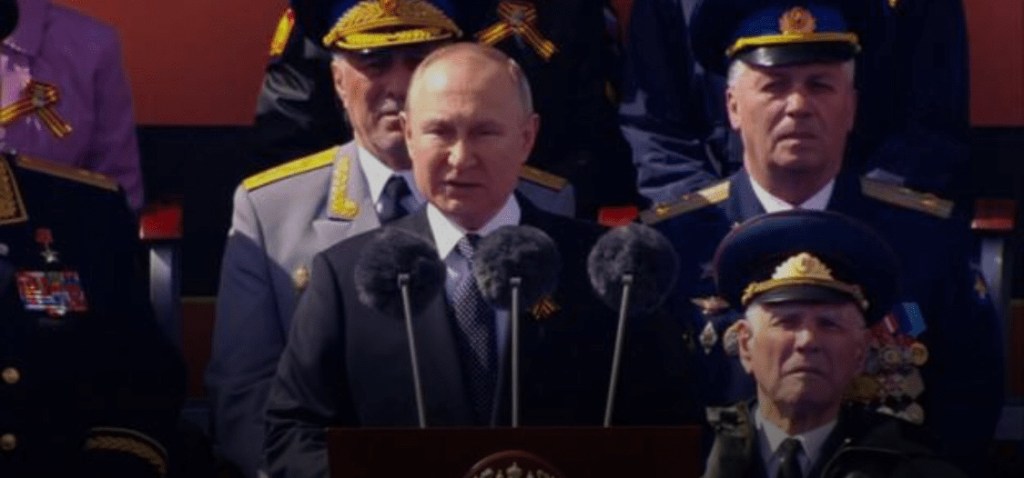
Russian President Vladimir Putin said Russian forces in Ukraine were fighting for the future of their motherland, in his annual address marking victory over Nazi Germany in World War Two.
Despite rumours he would make a major announcement his speech stuck largely to defending Russia’s invasion.
He tied the war in Ukraine to victory in 1945, blaming the West and Nato for rejecting security demands.
Almost 10 weeks into the invasion, civilian casualties continue to mount.
Some 60 civilians are feared dead in the eastern town of Bilohorivka, after a Russian attack on a school where people were trying to escape bombardment.
Flanked by military top brass, Russia’s leader spoke of Ukrainians as fascists, repeating his false claim that the democratic government in Kyiv was run by neo-Nazis.
Defending the motherland had always been sacred, he said, referring to the eastern region which is now the main focus of Russia’s assault: “Today you are fighting for our people in Donbas, for the security of Russia, our homeland.”
He also made unfounded allegations against Nato and Ukraine and described the invasion as a pre-emptive rebuff: “They were preparing a punishing operation in Donbas to intrude on our historic lands. In Kyiv they were saying they might get nuclear weapons and Nato started exploring the lands close to us, and that became an obvious threat to us and our borders.”
There had been speculation that Russia’s president may be considering a change of military strategy, either a full declaration of war, rather than the current so-called special military operation, or a mobilisation of Russian men to boost the armed forces.
Instead, he said he was signing a decree for families of the dead and wounded in Ukraine to receive special support.
















 Congo.dev