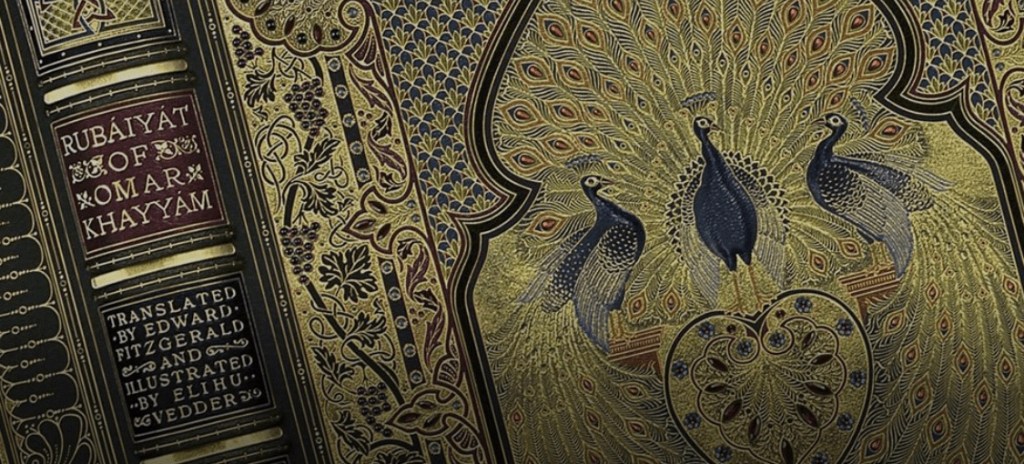
One of the most lavishly decorated books the world has seen was despatched from London to New York in April 1912.
The jewel-encrusted edition of the Rubáiyát of Omar Khayyám was taken aboard the RMS Titanic and sank to the bottom of the Atlantic Ocean, exactly 110 years ago.
A replacement was finished at great expense by the late 1930s but it was promptly incinerated by German bombers as the British capital was ravaged during the Blitz.
The young man behind this extravagant presentation of the polymath Khayyám’s poetry would soon drown in an English seaside resort.
Would anyone dare to commission a third “Great Omar”?
‘The greater the price the more I shall be pleased’
In 1911, Francis Sangorski finished work on a binding he had been labouring over at his Holborn workshop for two years.
It was breathtakingly magnificent.
Measuring 16in by 13in (40cm by 35cm), the book was encrusted with 1,050 jewels including specially cut rubies, topazes and emeralds. About 100sq ft (9sq m) of gold leaf and some 5,000 pieces of leather were used in its creation.
Sangorski agonised over every detail, at one point borrowing a human skull so he could accurately depict it in his artistic vision. He even bribed a keeper at London Zoo to feed a live rat to a snake so he could capture the grisly image from first-hand experience.
The Daily Mirror considered the finished work to be “the most remarkable specimen of binding ever produced”. Others simply described it as the “Book Wonderful”.
It was given an enormous price tag.
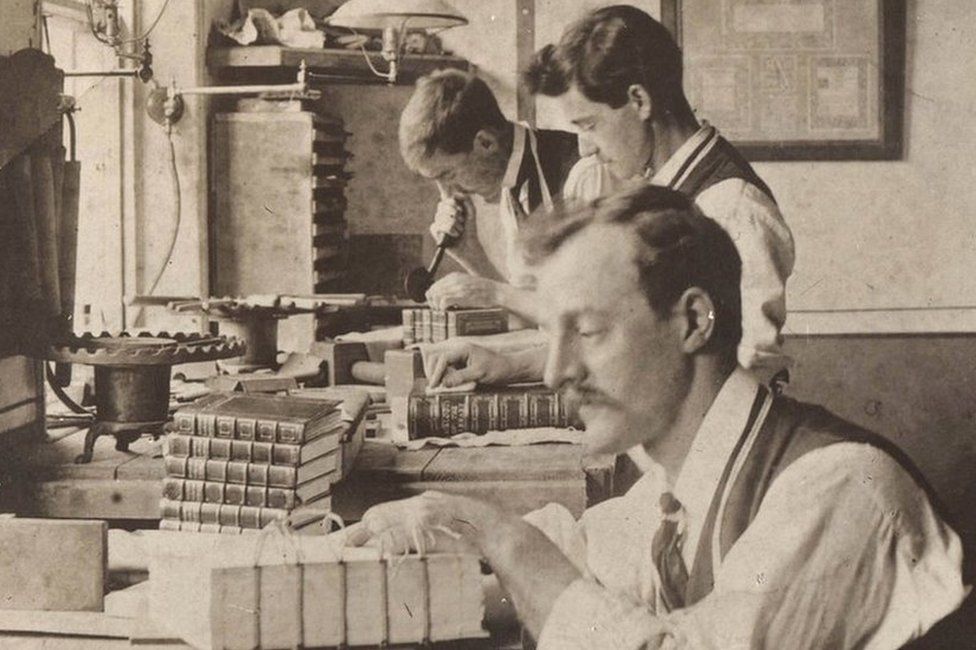
Bookbinder Sangorski and his business partner George Sutcliffe were already highly regarded for their elaborate jewelled covers.
“Real jewelled bindings were like Fabergé eggs,” explains Rob Shepherd, managing director of Shepherds, Sangorski & Sutcliffe – the 21st Century iteration of the company the two men set up in the Edwardian era.
“They were of a level which would be very hard to replicate today as there’s been a loss of skills over the years. The trade in those days was very skilled. They were extraordinarily talented craftsmen.”
The pair had met in 1897 at evening classes, where they were taught by the best as apprentices to a line of craftsmen who went back to the Arts and Crafts movement’s William Morris and included the eccentric TJ Cobden-Sanderson – a man who ended his career by throwing blocks of his own typeface off Hammersmith Bridge and into the River Thames so that nobody could copy him.
Sangorski and Sutcliffe’s work stood out and they won prestigious bookbinding commissions, including for King Edward VII.
 Congo.dev